


Introduction
The multi cloud security architecture is now essential due to the fact that many organizations are using multiple cloud platforms to support their operations. Now constituting a cloud growth engine, organizations of all types are sending data, applications, and workloads to multiple providers for agility and resiliency, but with that has come new security exposure.
A comprehensive multi-cloud security strategy helps you secure sensitive materials, retain visibility, and reduce risk across disparate cloud environments. As digital solutions grow, keeping data secure, managing the security risks with a better strategy is no longer optional it is necessary.
In this article, you will learn all about multi-cloud security architecture, what it is? and how it works?, why it matters in current times? and how businesses can build a secure & scalable framework that supports growth while keeping their cloud environments protected.
What Is Multi Cloud Security Architecture?
Secure multi cloud architecture is a structure that safeguards data and apps across multiple clouds. Instead of working with a single provider, businesses work across multiple clouds and require a consistent way to monitor security.
Single-cloud security is easier to manage than multi-cloud security. In a multi-cloud setup, each cloud platform has its own security settings and tools. Making a strong multi cloud security strategy is important because without this it becomes harder for companies to properly secure their systems.
What Is The Importance Of Multi-Cloud Security Architecture?
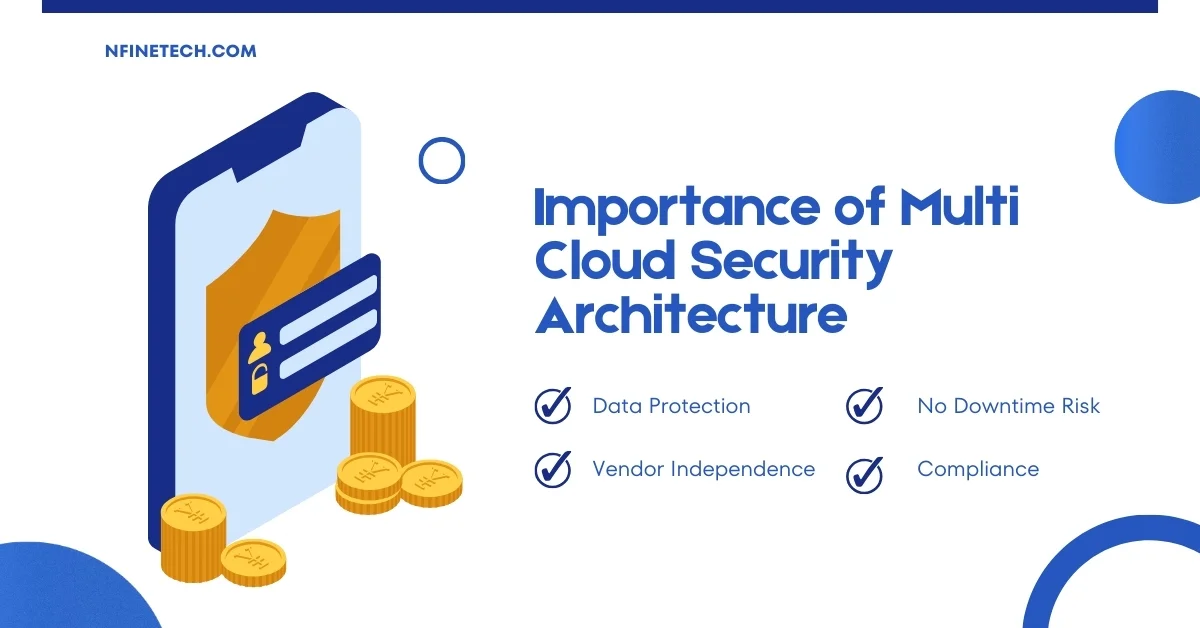
Multi cloud security is a vital aspect. Over time, this has been seen as the primary reason why a lot of businesses have been using different cloud services to cover their core activities. It is not only protecting the data, but it is also minimizing the risks to the least possible level and meeting all the compliance requirements. If there are no security measures that are sufficient, the companies will suffer from data loss, unavailability of systems, and huge penalties imposed by regulators.
Reasons Why Multi Cloud Security Architecture Is Important?
- Data Protection: It protects sensitive information belonging to the business and its customers through clouds.
- Vendor Independence: It lessens the dependence on one supplier and reduces the impact of the specific vendor’s risks.
- Less Downtime and Risk: A multi-cloud security architecture help companies stay operational during failures by backing up workloads across different environments. In such a case where one cloud fails, systems can continue running securely on another cloud.
- Maintenance of Compliance and Governance: It makes the company adhere to both the rules set by the outside and the ones established internally.
What Are The Key Components of Multi-Cloud Security Architecture?
Multi cloud security is extremely important for businesses. Many companies use multiple cloud platforms to keep their core systems and data safe because strong security not only protects data from unauthorized access but also reduces risks and helps companies meet legal and compliance requirements. Without proper security, businesses may face data loss, system downtime, and heavy fines from regulators. Below are some reasons that why multi cloud security architecture is important.
Reasons Why It Is Important:
- Identity and Access Management (IAM): It is the identification of the users allowed to access the cloud resources, and least-privilege policies are enforced as a rule.
- Data Encryption Across Clouds: It ensures that the most sensitive information is not only impossible to reach and steal but also during the transfer, and while it is in the cloud provider’s storage, the data is safe.
- Network Security Controls: It is basically the protection of the cloud networks by firewalls, segmentation, and secure connectivity.
- Security Monitoring and Visibility: It enables continuous observation of the risks, deviations, and non-compliance areas.
- Policy Management and Automation: It guarantees the uniform application of security policies throughout all clouds and, in addition, the automation of tedious tasks eradicates human errors.
What Are Significant Problems Of Multi Cloud Security Architecture?
Security management across different cloud platforms comes with some significant challenges. They have to address them early and properly handle If not, these issues can lead to data loss, compliance failures, and disruptions to business operations.
Main Problems:
- No Visibility: It is not easy to keep track of the assets, data, and activities in the various cloud environments.
- Misconfigurations: The setup mistakes can create open spots where the attackers can get in.
- Inconsistent Security Policies: Different clouds may need different sets of rules, which will result in unintentionally insecure areas.
- Compliance Risks: To be compliant with the laws and regulations of the different vendors is a very complicated and exhausting task.
- Increased Attack Surface: More cloud points of presence and services imply higher chances for threats to get in.
How to Secure a Multi-Cloud Architecture
A multi-cloud environment can be secure only through a well-organized method for data protection, access control, and risk minimization. The application of these strategies not only guarantees uniform security but also allows for operational efficiency.
Main Strategies:
- Centralized Security Management: Control, approve, and monitor actions from a single place, which will lead to a clearer view of the security situation.
- Zero Trust Security Model: Each request for access will be checked, and there will be an assumption that the user or system is not trusted by default.
- Standardized Security Policies: Apply the same security protocols everywhere across cloud providers in order to cut off the attack surface.
- Continuous Monitoring: Keep an eye on the whole process, identify the dangers, and then help out right away.
- Automated Security Workflows: Make daily security tasks matter-free to avoid human mistakes and save time.
Multi Cloud Security Architecture vs Single Cloud Security
Understanding the differences between single cloud and multi cloud security helps businesses choose the right cloud strategy. While a multi cloud security setup is more beneficial for some businesses as it comes with more flexibility and a backup option but it also adds complexity and must be managed very carefully.
A Quick Comparison:
- Single Cloud: More straightforward to handle, fewer points for integration, and lower complexity.
- Multi Cloud: Gives a backup plan, prevents switching to a single vendor, and increases durability.
Pros and Cons Of Single & Multi Cloud Security Architecture:
- Pros of Multi Cloud: It is more flexible, better uptime, better performance and vendor independence etc…
- Cons of Multi Cloud: Hard to manage due to complexity, have potential security gaps, and higher operational costs.
When To Use Multi Cloud Security Architecture?
- When you want to distribute workloads across multiple providers.
- For avoiding single points of failure.
- When scaling operations globally while maintaining resilience.
Multi Cloud Security Solutions and Tools
To implement a strong multi-cloud security structure, the right tools are needed to safeguard data and check the actions on the various platforms. The following are some of the key solutions that keep security, visibility, and compliance intact:
- Cloud Security Posture Management (CSPM) is positioned: It verifies that your cloud arrangement complies with the latest industry standards and regulations.
- Cloud Workload Protection Platforms (CWPP): guard application workloads in different clouds while simultaneously allowing manual operations of detection and response to threats.
- Identity Governance Tools: Monitor user rights and apply policies to totally occlude the risk of unauthorized actions.
- SIEM and SOAR Solutions: Data is gathered, vulnerabilities are assessed, and the response to incidents is done automatically in the cloud.
How to Design a Scalable Multi-Cloud Security Architecture?
Creating a scalable multi-cloud security architecture for your company will be a process that consists of careful planning and execution. A methodical way of doing things not only makes it easier for you to implement security measures, but it also guarantees that the measures will be the same and effective throughout the whole cloud deployment.
Planning:
- Evaluate the needs of the company and the most important tasks.
- Point out the possible security threats for every cloud provider.
- State the policies and governance frameworks unequivocally.
Execution:
- Set up the implementation of security measures that are centralized for identity verification, network, and data protection.
- Introduce the use of automated tools that will apply the policies across the different clouds.
- Make sure the encryption and access control practices are the same for all the clouds.
Test:
- Conduct Vulnerability Scans and Penetration Testing across the system.
- Perform security incident simulations and test the company’s responsiveness to such incidents.
- Verify the ability of the notification tools to alert all the environments concerned of the issues that are relevant.
Improving:
- Regularly adjust the policies with respect to the data from monitoring and the intelligence gathered about the threats.
- Expand the security controls in line with the increase in the usage of the cloud service.
- Take advantage of multi-cloud security solutions to boost efficiency and keep compliance.
Future Trends in Multi-Cloud Security Architecture
Multi-cloud security is the fast moving frontier that brings along with it new vulnerabilities and threats that organizations must learn to deal with, at times even turning the very trends that they are following into their allies in the battle for security and operational efficiency:
AI-Powered Security: The use of AI and ML is critical in the fully automatic detection of anomalies, in the prediction of threats, and the performance of measures that minimize the necessity of human participation while at the same time increasing the precision.
Zero Trust Extension: The complete implementation of zero trust in all cloud environments ensures that every access request will be authenticated, thereby greatly lowering the risks that come with stolen credentials or insider threats.
Policy Automation: The implementation of automated security policies among different clouds has a low rate of human error, high compliance, and uniform protection as the cloud infrastructure expands.
Unified Security Platforms: The attractiveness of platforms that join forces in monitoring, threat detection, and policy enforcement over various cloud vendors is the impact they have in terms of reducing the complexity of operations and offering a more widespread view of the security landscape
Conclusion
Modern enterprises must create a protective multi-cloud security setup that is hard to break to be able to enjoy the benefits of the cloud computing. It helps in the protection of sensitive information, the meeting of regulatory requirements, and the risk of loss reduction while enabling growth.
If companies adopt cutting-edge AI security and policy automation, firms will implement a secure, disaster-proof, and scalable multi-cloud environment just by following the best practices and using the multi-cloud security solutions. Permanent victories will be built on regularity, active supervision, and selecting reliable tools and methods for a solid multi-cloud security framework.
